
A unique wedding tradition was observed in Prayagraj, where on Monday, a bride named Tanu, hailing from Kidganj, brought her own baraat to the groom’s house in Muthiganj. In a surprising twist to traditional wedding customs, it was the bride’s family that arrived with the baraat, and they were warmly welcomed with music, dancing, and joy. The sight of Tanu and her family dancing to the beats of a DJ while heading towards the groom’s residence has become a viral sensation on social media.
A Traditional Wedding with a Twist
In most weddings, it is customary for the groom and his family to travel to the bride’s home, but this wedding in Prayagraj broke the norms. Tanu, with her family and close ones, took the traditional procession to the groom’s house instead. On reaching the groom Rajat’s house, her family was greeted with enthusiasm. The ceremony took place in a festive atmosphere, with music filling the air, creating a joyful and celebratory mood.
The event has gained attention on social media, with the video of Tanu’s baraat circulating widely. The wedding is being celebrated as an example of how modern customs can blend with traditional values in a creative way. This unexpected turn has fascinated both local communities and social media users alike.
The Wedding Ceremony: A Festive and Heartwarming Celebration
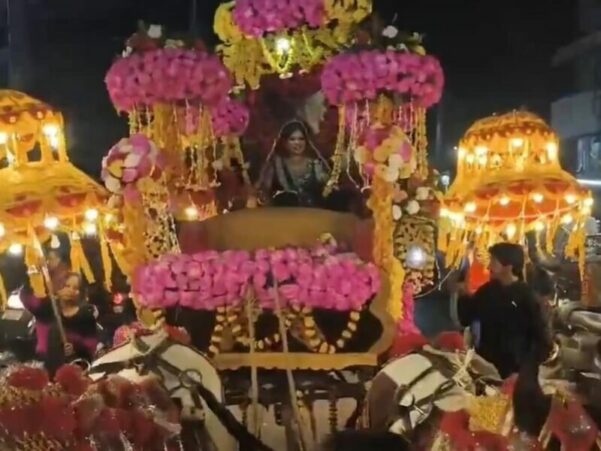
The wedding season in Prayagraj is in full swing, with the sounds of shehnai and dholak filling the streets. In the midst of this festive season, Tanu’s unique wedding procession added a special touch to the celebrations. On Monday, Tanu, a resident of Kidganj, arrived at her husband’s house in Muthiganj with her own baraat. The procession was filled with excitement as she arrived on a decorated chariot. The vibrant celebrations included Tanu’s four sisters, relatives, and around 100 people who joined the procession.
Tanu’s elder sister, Swati, shared that Tanu’s marriage had taken place on November 20. After the wedding, Tanu returned to her parental home and, on Monday, made her way back to her in-laws’ house in a grand procession for the pre-wedding feast. The baraat was welcomed at the groom’s house with a shower of flowers and a traditional aarti.
The Heartwarming Gesture of the Groom’s Father
The father of the groom, Rajesh Jaiswal, a private-sector employee, had five daughters but no sons. His desire was to conduct his daughter’s wedding in the same grand manner as a son’s wedding would be celebrated. To fulfill this wish, Rajesh had a special card printed that read, “Our daughter’s baraat.” This gesture touched everyone involved in the ceremony, adding a personal and emotional element to the wedding celebrations.
The baraat, which began at 6 PM from Kajal Cinema, was a sight to behold as Tanu, sitting on a chariot, made her way to her husband Rajat’s house. The arrival of the baraat was an emotional and joyous moment for both families, symbolizing the bond and union that weddings represent.
A Celebration of Family and Tradition
In a society where traditional gender roles often dictate the flow of wedding ceremonies, Tanu’s action of leading the baraat was a refreshing change. It displayed the strength and unity of family ties and showcased how love and celebration can transcend traditional boundaries. This ceremony was a clear reflection of how modern elements can be seamlessly integrated into age-old traditions.
The emotional connection shared by Tanu’s family, especially her father, resonated with the crowd and became a central theme of the wedding. As the procession continued with music and dancing, it became clear that this was not just a wedding but a celebration of love, unity, and family pride.
Challenges in Weddings: A Contrasting Incident from Shahjahanpur
While Tanu’s wedding celebration was a heartwarming success, another wedding in Shahjahanpur created quite a stir. During a wedding there, a major commotion occurred when the groom’s former girlfriend arrived at the wedding and caused chaos. The bride, upon hearing about the incident, decided to call off the wedding. In the aftermath, the wedding procession returned without the bride, and the bride’s family filed a police complaint to reclaim the dowry.
This stark contrast in the two wedding stories highlights the varying experiences and emotions surrounding weddings in different contexts. While one wedding became a symbol of familial love and celebration, the other was marked by conflict and disappointment, drawing attention to the complexities that sometimes accompany marital unions.
Social Media Reactions to Tanu’s Baraat
Tanu’s decision to lead her own baraat has sparked a wide range of reactions from social media users. Some users have praised her for breaking traditional norms, while others have mocked the unusual practice. The viral video has become a talking point for many, especially in the context of how modern weddings are evolving in India. Tanu’s actions have brought attention to the flexibility of traditional customs, showing that love and family bonds can lead to new interpretations of longstanding practices.
As social media continues to buzz with reactions, it is clear that this unique wedding procession has become a symbol of innovation in tradition. Whether viewed as an unconventional gesture or a creative twist on a timeless tradition, Tanu’s baraat has captured the imagination of many.
Tanu’s wedding in Prayagraj has introduced a refreshing new take on traditional wedding customs. By leading her own baraat to her husband’s home, she not only created an unforgettable moment for her family but also set an example of how age-old customs can be reinterpreted to reflect contemporary values. The warm reception and celebrations that followed were a testament to the love and joy shared by both families.
While this may be a rare occurrence, Tanu’s wedding procession highlights how individuals can challenge traditional roles and expectations, making weddings more personalized and meaningful. The heartwarming nature of the ceremony and the powerful family connections it showcased have made it an event to remember. As society continues to evolve, such creative celebrations may become more common, offering a new way of honoring tradition while embracing modernity.