

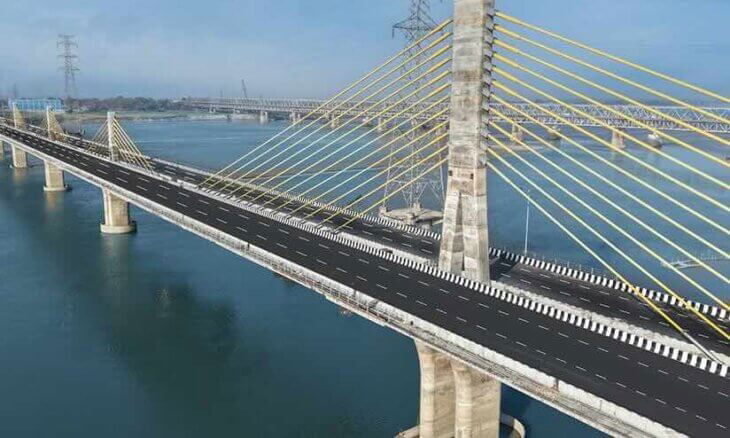
Bihar has made significant strides in infrastructure development this year, setting a new benchmark in the field of bridge construction. After showcasing its model in several schemes, the state has achieved another milestone with the inauguration of the six-lane bridge over the Ganga River between Patna and Begusarai. The Auhta-Simaria Bridge, which was inaugurated on August 22, by Prime Minister Narendra Modi and Chief Minister Nitish Kumar, is not just a six-lane bridge but also the widest bridge in the country. This project marks a new chapter in Bihar’s infrastructure history.
Inauguration and Key Features of the Auhta-Simaria Bridge
The Auhta-Simaria Bridge is unique in its design and construction. The typical width of six-lane bridges in India is around 29.5 meters, but this bridge spans 34 meters, making it the widest of its kind in the country. The bridge is based on the expansion cable bridge technology and is supported by 18 pillars. On either side of the bridge, there are three lanes for vehicles, which ensures smooth and efficient traffic flow.
A significant feature of this bridge is the large rotary constructed at both ends. The rotary near Auhta is 100 meters wide, while the one at Simaria is 80 meters. This area has been developed into a park, making it both functional and aesthetically appealing. This design has helped reduce congestion and improved overall traffic management in the region.
Benefits of the Auhta-Simaria Bridge
The construction of the Auhta-Simaria Bridge has significantly improved connectivity between South Bihar and North Bihar. With the improved road network, heavy vehicles can now travel effortlessly between districts like Patna, Sheikhpura, Nawada, Lakhisarai, and Begusarai, Supaul, Madhubani, and Araria. The bridge has reduced the travel distance by nearly 100 kilometers, saving both time and transportation costs for travelers and businesses.
In addition to providing smoother traffic, the bridge also facilitates the operation of cargo ships under the bridge. This aspect of the bridge will help boost trade and logistics in the region, enhancing the overall economic activity of the area.
Financial Investment and Economic Impact
The total cost for the construction of the Auhta-Simaria Bridge was 1871 crores, a significant investment in the state’s infrastructure. The economic impact of the bridge is already being felt, as it has improved the movement of goods and people between critical districts in Bihar. By reducing travel time and enhancing transport efficiency, the bridge is playing a crucial role in lowering transportation costs, benefiting businesses, and improving the overall economic landscape of the state.
Impact on Regional Connectivity and Tourism
Apart from boosting trade and logistics, the bridge has also enhanced connectivity to important cultural and historical sites in Bihar. One such location is Simaria Dham, the birthplace of the renowned poet Ramdhari Singh Dinkar. The improved connectivity to this site is expected to increase tourism in the area, drawing more visitors and pilgrims to the region.
A Vision Realized: From Concept to Completion
The idea for the Auhta-Simaria Bridge was first proposed in 2015 when Prime Minister Narendra Modi announced a special package of 1.25 lakh crores for Bihar during a public rally in Ara. The announcement included the construction of this bridge as part of Bihar’s long-term infrastructure development plan. After years of planning and construction, the bridge is now complete and serves as a vital link between two major parts of the state.
Significance for Bihar’s Infrastructure and Future Growth
The completion of the Auhta-Simaria Bridge is a landmark event in Bihar’s infrastructure development. It not only improves transportation and logistics but also sets the stage for future growth in the region. The bridge will play a pivotal role in enhancing Bihar’s connectivity with the rest of the country, thus opening up opportunities for further economic development.
The state government, along with the central government, has made significant investments in infrastructure over the past few years, and the Auhta-Simaria Bridge is a testament to these efforts. This bridge stands as a symbol of Bihar’s commitment to improving its infrastructure and supporting economic growth.
The Auhta-Simaria Bridge is not just an engineering marvel but also a symbol of progress for Bihar. The bridge has transformed the way people and goods move across the state, providing significant benefits to both the economy and the residents of Bihar. This project has set a high standard for future infrastructure projects and demonstrates the positive impact of such investments on regional development. With the completion of this bridge, Bihar continues to strengthen its position as a state committed to growth, development, and progress in all aspects of life.